 DE
DE  EN
EN  ES
ES  RU
RU  AR
AR  TR
TR 




One of the biggest hurdles on the way to Germany is learning the language. German is not exactly known for being easy to learn; as Mark Twain, the famous American author, once said: "Life is too short to learn German." ;-)
The reasons for this lie, for instance, in the fact that there are three genders (der, die, das) and four cases (Nominative, Genitive, Dative, Accusative), which can also change depending on their function in the sentence. However, those who already speak good English have a bit of an advantage.
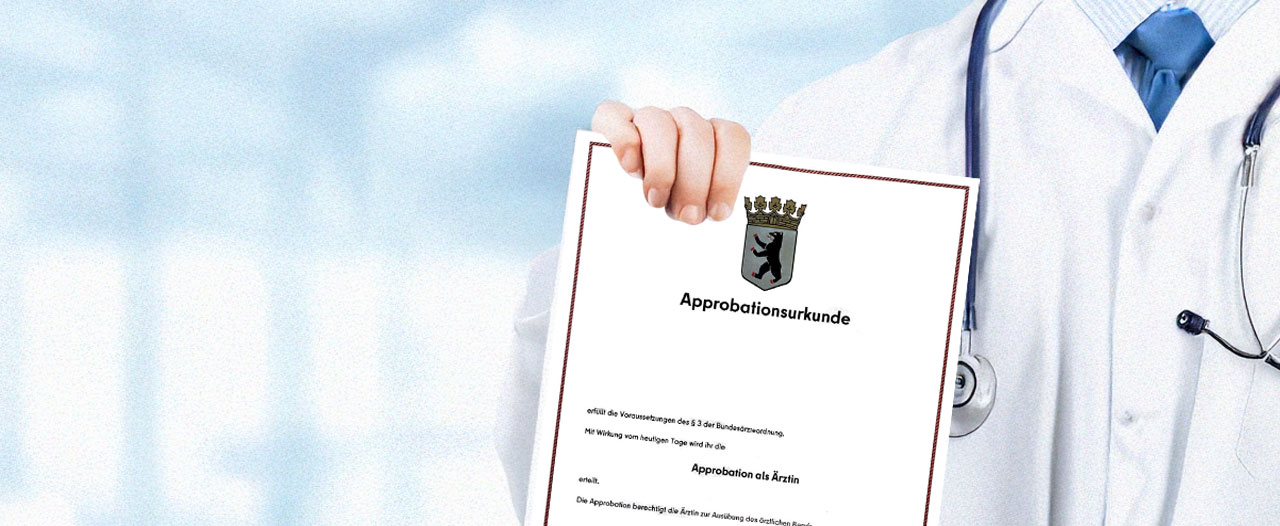
In general, it can be said: The key to a successful application for the Approbation (medical license) and optimal integration is the language. Learning German—learning, learning, learning—will define your life from the moment you decide to come to Germany.
How long you need to learn the German language naturally depends, among other things, on whether you have a knack for languages. Assuming that you attend courses and that one course consists of teaching units (UE) of 45 minutes each, you can roughly work with the following figures:
- A1 (Beginner): approx. 100 – 150 UE | Duration: approx. 2 months
- A2 (Basics): approx. 150 – 200 UE | Duration: approx. 2-3 months
- B1 (Intermediate): approx. 150 – 200 UE | Duration: approx. 2-3 months
All assumptions are based on approx. 3 UE per working day (Monday to Friday).
In a standard course, general German skills are acquired during these stages. There are very few language schools that incorporate medical examples this early on. However, YANA collaborates with a language school in Berlin that does exactly that, which of course enormously simplifies the path to further learning involving medical content later on.
After these 6 to 8 months of language training, you will be able to communicate in everyday life, but in a hospital setting, you would still be completely lost.
An important milestone: B2 (Independent Language Use)
The B2 certificate is the absolute minimum requirement for almost every official application (visa, professional permit/Berufserlaubnis, Approbation). Since the B2 certificate is usually a prerequisite for a visa, you will likely learn up to at least level B2 in your home country. By then, you will understand a lot, but forming sentences yourself will still be difficult for you. This is partly because courses usually offer few opportunities to speak actively due to the higher number of participants. You can find some tips on this below.
For acquiring the B2 certificate, count on an additional requirement of 200 to 250 UE, i.e., another 3 to 4 months.
Total balance from 0 to B2: with disciplined learning, 10 to 12 months.
Once you have managed the already arduous path to B2, your motivation to continue learning will certainly increase even further. You can now basically communicate, recognize contexts, and further develop your German more effectively. The next goals are now General C1 Level and the Medical Language Examination (Fachsprachprüfung – FSP). Here, you should expect another 6 to 9 months. A special preparation course for the FSP is definitely recommended. Under certain conditions, you can receive funding for this from the employment agency (Arbeitsamt) in Germany.
In a special FSP course, you will be prepared for the Medical Language Examination at the State Medical Association (Ärztekammer). The contents include:
- Anamnesis interview (Doctor-Patient)
- Doctor’s letter / Medical report
- Doctor-Doctor discussion
These special courses usually last 3 to 5 months (often 400 – 600 UE), and you should really only participate in them once you already have a stable B2/C1 general level, meaning not immediately after passing your B2 certificate.
Tips for Learning:
Listen to German radio stations. If you repeat sentences out loud every now and then, you train your pronunciation habits; forming sentences will gradually become easier, as will your pronunciation. Links to recommended radio stations:
- https://www.inforadio.de/ – A pure news station without music.
-https://www.radioeins.de/ – A very good mix of spoken contributions on all sorts of topics and music.
- https://www.deutschlandradio.de/ – Various channels on different topics.
Streaming Services: Of course, it also helps if you turn on German subtitles for films in your own language on streaming services. Or, even better, watch these films in German with subtitles in your language. This enormously trains your comprehension; you hear how sentences are formed, and it will help you greatly with further learning.
Recommended YouTube Channels:
- https://www.youtube.com/@EasyGerman – New videos twice a week.
- https://www.youtube.com/@DeutschmitMarija – Good videos, also for exam preparation.
- https://www.youtube.com/@BenjaminDerDeutschlehrer – Learn German with short stories.
Commercial Offer: You can find a commercial offer with potential personal tutoring at https://www.germantogo.com/. Here, there is a structured progression from 0 to, for example, B2, which can also be booked with personal lessons upon request.
And as always: If you have any questions, please do not hesitate to contact us.
Transparency Notice: YANA operates independently, without affiliations or commissions. This information is provided for informational purposes only.