 DE
DE  EN
EN  ES
ES  RU
RU  AR
AR  TR
TR 


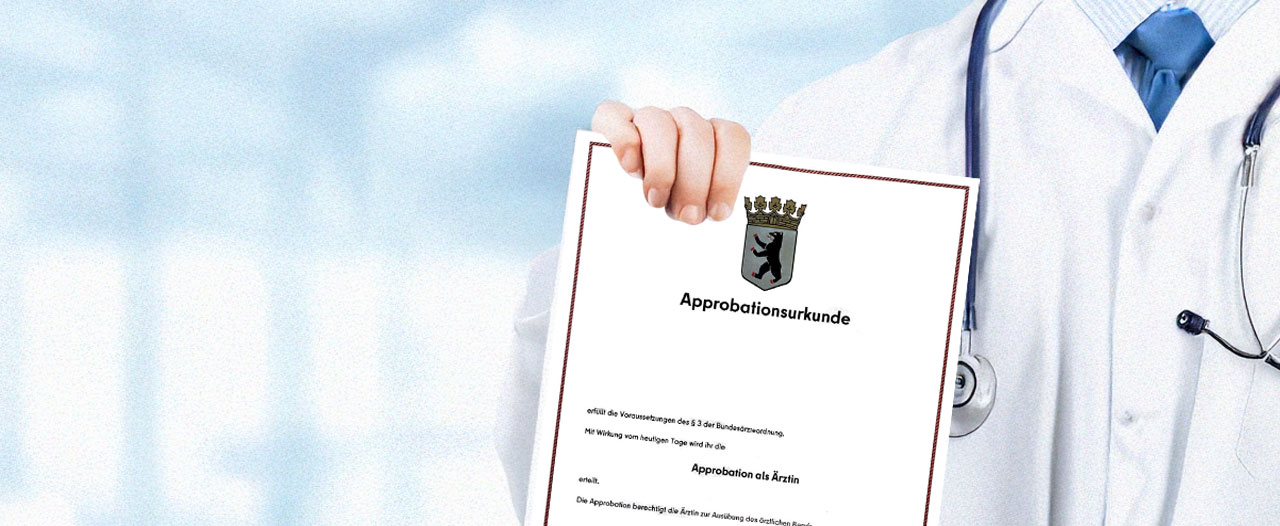

Legal Amendment to the Medical Licensing Process Starting this Autumn: The New Acceleration Act from November 2026
- Detalles
- Categoría: Blog
- Read Time: 6 mins
The German Federal Government has taken decisive action: To counteract the acute shortage of doctors, the "Act to Accelerate the Recognition Procedures for Foreign Professional Qualifications in Healthcare Professions" will enter into force on November 1, 2026. For physicians from third countries (non-EU/EEA), this ostensibly marks the beginning of an entirely new era.
Away from paralyzing bureaucracy, towards a clear, exam-oriented system. This article outlines precisely what is changing and how you can benefit the most from this reform.
Fundamental Changes for Foreign Physicians
1. The Direct Medical Knowledge Exam (Kenntnisprüfung) Becomes the New Standard
Previously, every procedure legally defaulted to a highly complex, months-long document review process (equivalence assessment), which was statutorily mandated. A medical knowledge exam was only administered if professional deficits were identified based on the submitted documents that could not be compensated for through courses or internships.
As of November 2026, the direct knowledge exam will be elevated to the legal standard for graduates from third countries. As a rule, authorities will forgo the time-consuming, detailed review of foreign curricula. Accordingly, the knowledge exam is now officially anchored in the statutory text as a fully-fledged professional licensing examination.
2. Binding Right of Option and Irrevocable Waiver
Although you retain the right to request a document-based equivalence assessment, you must make this decision within four weeks of submitting your application. If you formally declare your waiver of the equivalence assessment to the authority in order to take the knowledge exam, this decision is final and irrevocable. Switching back to the document review process at a later date is legally prohibited.
3. Absolute Obligation to Prove "Completion"
The law also makes it unequivocally clear: No procedure can be initiated without formal proof of the full completion of the medical qualification in the country of origin.
Important Exception: Should you be unable to fully submit the necessary detailed documentation due to objective reasons beyond your control (such as war or displacement), the path to the knowledge exam remains open to you.
4. Measures Against "Procedure Tourism"
To prevent applicants from simply restarting the process in another federal state after a rejection—which was previously possible due to a lack of data synchronization—this inter-authority data alignment is now being massively tightened. In the future, state authorities will be permitted and enabled to digitally query in real-time whether a procedure is already underway or has been legally and bindingly rejected in another federal state.
Financial and Time Relief
The National Regulatory Control Council (an independent advisory body for federal legislative review) has calculated the impact of the new law in detail. The savings for you as an applicant are drastic: we are talking about approximately €3,000 per applicant, as the copying, translation, and notarization of extensive curricula will generally be completely eliminated.
The planned reduction of bureaucracy is definitely a positive development. In the future, curricula from foreign universities will neither have to be procured nor sent to the authorities after costly and complex legalization. Furthermore, a significant acceleration of processing times at state authorities is expected due to the elimination of lengthy equivalence assessments.
Our Assessment
The law merely codifies what many authorities have already been practicing for some time. Since the central review office (GfG) in Bonn did not accept any applications for a long period (from 2024 to April 2026) and only a few federal states employ their own assessors, several states have—illegally but pragmatically—been sending out the offer to take the medical knowledge exam (Kenntnisprüfung) along with the acknowledgment of receipt for a while now.
Regarding the aforementioned cost savings, we believe that focusing solely on the €3,000 saved on translation and notarization costs is short-sighted. The expert assessment process could be initiated and awaited from abroad, meaning applicants could still live in their social environment and earn a living. However, prior to taking the knowledge exam, most physicians will likely want to attend a preparatory course, which can cost anywhere from around €1,200 (for a pure video self-study course) to €5,000 (for an on-site intensive course). In the case of an in-person course, living expenses in Germany must also be factored in.
Furthermore, it remains to be seen how quickly the additional capacity required for an expanded offering of knowledge exams can be established. Even though an estimated 70% of medical professionals previously chose the document review path, waiting times for the knowledge exam in the federal states already ranged from 4 to 15 months. If the number of required exams now doubles or even triples, the availability of knowledge exams must be massively expanded here. We will stay on top of this and hope for a rapid, positive development.
Update as of August 7, 2026:
Following discussions with several licensing authorities (Approbationsbehörden), we have been informed that the new law will have an additional impact. Previously, the expert evaluation route (Gutachterweg) was enshrined by law as the standard procedure. If, for instance, documents were missing or unclear, they were formally requested, and the process was paused until these documents could be submitted to the authority. However, once the new law comes into effect, authorities will move much more quickly to direct applicants to take the knowledge exam (Kenntnisprüfung) whenever documentation is missing or insufficient. This is a crucial point for anyone who prefers the expert evaluation route.
Roughly how long does it take to learn German?
- Detalles
- Categoría: Blog
- Read Time: 4 mins

One of the biggest hurdles on the way to Germany is learning the language. German is not exactly known for being easy to learn; as Mark Twain, the famous American author, once said: "Life is too short to learn German." ;-)
The reasons for this lie, for instance, in the fact that there are three genders (der, die, das) and four cases (Nominative, Genitive, Dative, Accusative), which can also change depending on their function in the sentence. However, those who already speak good English have a bit of an advantage.
In general, it can be said: The key to a successful application for the Approbation (medical license) and optimal integration is the language. Learning German—learning, learning, learning—will define your life from the moment you decide to come to Germany.
How long you need to learn the German language naturally depends, among other things, on whether you have a knack for languages. Assuming that you attend courses and that one course consists of teaching units (UE) of 45 minutes each, you can roughly work with the following figures:
- A1 (Beginner): approx. 100 – 150 UE | Duration: approx. 2 months
- A2 (Basics): approx. 150 – 200 UE | Duration: approx. 2-3 months
- B1 (Intermediate): approx. 150 – 200 UE | Duration: approx. 2-3 months
All assumptions are based on approx. 3 UE per working day (Monday to Friday).
In a standard course, general German skills are acquired during these stages. There are very few language schools that incorporate medical examples this early on. However, YANA collaborates with a language school in Berlin that does exactly that, which of course enormously simplifies the path to further learning involving medical content later on.
After these 6 to 8 months of language training, you will be able to communicate in everyday life, but in a hospital setting, you would still be completely lost.
An important milestone: B2 (Independent Language Use)
The B2 certificate is the absolute minimum requirement for almost every official application (visa, professional permit/Berufserlaubnis, Approbation). Since the B2 certificate is usually a prerequisite for a visa, you will likely learn up to at least level B2 in your home country. By then, you will understand a lot, but forming sentences yourself will still be difficult for you. This is partly because courses usually offer few opportunities to speak actively due to the higher number of participants. You can find some tips on this below.
For acquiring the B2 certificate, count on an additional requirement of 200 to 250 UE, i.e., another 3 to 4 months.
Total balance from 0 to B2: with disciplined learning, 10 to 12 months.
Once you have managed the already arduous path to B2, your motivation to continue learning will certainly increase even further. You can now basically communicate, recognize contexts, and further develop your German more effectively. The next goals are now General C1 Level and the Medical Language Examination (Fachsprachprüfung – FSP). Here, you should expect another 6 to 9 months. A special preparation course for the FSP is definitely recommended. Under certain conditions, you can receive funding for this from the employment agency (Arbeitsamt) in Germany.
In a special FSP course, you will be prepared for the Medical Language Examination at the State Medical Association (Ärztekammer). The contents include:
- Anamnesis interview (Doctor-Patient)
- Doctor’s letter / Medical report
- Doctor-Doctor discussion
These special courses usually last 3 to 5 months (often 400 – 600 UE), and you should really only participate in them once you already have a stable B2/C1 general level, meaning not immediately after passing your B2 certificate.
Tips for Learning:
Listen to German radio stations. If you repeat sentences out loud every now and then, you train your pronunciation habits; forming sentences will gradually become easier, as will your pronunciation. Links to recommended radio stations:
- https://www.inforadio.de/ – A pure news station without music.
-https://www.radioeins.de/ – A very good mix of spoken contributions on all sorts of topics and music.
- https://www.deutschlandradio.de/ – Various channels on different topics.
Streaming Services: Of course, it also helps if you turn on German subtitles for films in your own language on streaming services. Or, even better, watch these films in German with subtitles in your language. This enormously trains your comprehension; you hear how sentences are formed, and it will help you greatly with further learning.
Recommended YouTube Channels:
- https://www.youtube.com/@EasyGerman – New videos twice a week.
- https://www.youtube.com/@DeutschmitMarija – Good videos, also for exam preparation.
- https://www.youtube.com/@BenjaminDerDeutschlehrer – Learn German with short stories.
Commercial Offer: You can find a commercial offer with potential personal tutoring at https://www.germantogo.com/. Here, there is a structured progression from 0 to, for example, B2, which can also be booked with personal lessons upon request.
And as always: If you have any questions, please do not hesitate to contact us.
Transparency Notice: YANA operates independently, without affiliations or commissions. This information is provided for informational purposes only.